Brave Explorers, Eventually Become Light: Shanghai Chuangzhi Academy 2025 Summer Camp
https://mp.weixin.qq.com/s/EhNPj5JHPGTaxFS7hYDiQQ
The summer camp schedule hasn’t been released yet; everyone is welcome to watch and ask questions!
 (I’m a junior) assisting the academy with some recruitment work, can introduce some experiences from a student’s perspective.
The academy has strong academic resources and excellent material conditions, mainly recruiting the 2026 cohort of doctoral students (direct PhD, master‑PhD, or general PhD are all acceptable; even those who haven’t received an offer can join, and other grade levels are also welcome), covering five major directions: scientific intelligence, embodied intelligence, multimodal, intelligent computing systems, and corpora.
Feel free to leave comments, ask friendly questions, and discuss! These are very new topics; if you’re unsure, you’re also welcome to observe! You can join QQ group 1044193589 for inquiries.
Translate the college introduction in the group
Shanghai Chuangzhi College is a brand‑new higher‑education institution established to cultivate China’s leading artificial‑intelligence talent. The college adheres to a “student‑centered, frontier‑driven” training philosophy and, through ultra‑high‑standard faculty, extraordinary training measures, and exceptional conditions, explores a China‑characteristic AI talent‑development program, aiming to nurture China’s AI leaders and build a world‑class AI innovation hub.
1. Ultra‑High‑Standard Faculty
Gathering Talent to Build a First‑Rate Faculty Team The college assembles a top‑tier faculty comprising full‑time mentors, part‑time mentors, and industry mentors, closely aligning with the “student‑centered” approach to teaching, scientific research, and talent development in a comprehensive, end‑to‑end manner. Currently, the college has 69 full‑time mentors (average age 36), more than 150 part‑time mentors from elite universities such as Tsinghua and Peking, and over 120 industry mentors from leading AI companies—including telecom operators, Tencent, Alibaba, Baidu, SenseTime—and emerging AI firms such as Jiliu and Minimax.
Integrating Resources to Build a Mentor‑Group Training System The primary model is a mentor‑group system: academic mentors are responsible for course guidance, scientific literacy development, and academic thinking expansion; industry mentors handle project practice guidance, industry‑thinking development, and frontier‑technology guidance. Students may choose mentors independently or request external experts as mentors based on their research direction. During their studies, they can change mentors and topics according to research progress and needs. A Tutor guidance mechanism is implemented, with full‑time mentors, post‑doctoral researchers, and senior PhD students forming the core team, centered on student needs, providing comprehensive guidance, joint creation, real‑time response, and “face‑to‑face” assistance.
2. Extraordinary Training Measures
The college has built a new “student‑centered” training model to develop future AI leaders who are at the forefront of technology and industry, possess hands‑on research and innovation experience, and meet the urgent demand for scientific and industrial advancement that existing university systems cannot independently fulfill.
Strengthening Patriotic Education The college has established a Party branch, equipping students with a complete ideological‑political education team. Department heads serve as class advisors, full‑time mentors act as class mentors for academic and research guidance, and dedicated counselors handle daily class education. Through diverse thematic activities such as dean‑student face‑to‑face sessions and red‑themed visits, the college inspires patriotism and a sense of mission.
Offering High‑Quality Frontier Courses A lightweight curriculum system is set up, with 14 professional courses—including 5 core foundational courses and 9 advanced specialty courses—requiring each graduate student to select at least 6 courses. A course‑iteration mechanism focuses on theory, engineering, and application dimensions, addressing course structure, content, and resources in parallel.
Innovative Flexible Study Options Regarding study duration, the college provides flexible pathways: students are expected to complete coursework in the first year but may adjust their plans as needed, with no mandatory length or minimum years. Graduation is allowed once the training program is completed and degree requirements are met. Degree evaluation follows a rigorous yet flexible standard, emphasizing the social or original value of academic outcomes and tolerating failure in high‑challenge projects.
Condensing Frontier Innovation Topics Guided by national strategies, frontier signals, and industry value, the college conducts deep research on next‑generation autonomous computing systems, corpora, and world knowledge, building a solid foundation for AI computing infrastructure and data. Driven by demand and problem orientation, the college collaborates with universities and enterprises on major national tasks, shaping benchmark research projects and engaging full‑time and part‑time mentors in frontier topics.
Building an Academic‑Cultural Ecosystem Centered on the “Chuangzhi Forum,” supported by mentor and student series, the college explores a “one‑body, two‑wings” academic framework, creating a unique scholarly culture. Activities such as the Chuangzhi Innovation Forum, full‑time mentor briefings, student seminars, and part‑time mentor presentations broaden student horizons and promote interdisciplinary exchange.
3. Exceptional Conditions Guarantee
Geographic Advantage The campus is located in the Xuhui West Bank North Yang AI Town, one of the first national strategic emerging‑industry clusters designated by the State Council, and a core AI education‑research‑industry zone in Shanghai and the country. The college occupies a newly built independent building of 27,000 m² for teaching and administrative use.
Computing Power Support The college has completed its computing‑resource layout, meeting daily teaching and research needs, with a near‑term goal of building a ten‑thousand‑GPU‑scale resource pool. Students participate in platform infrastructure optimization and cluster acceptance testing, gradually acquiring AI engineering skills required for cutting‑edge large‑model development, thereby cultivating AI infrastructure talent.
Entrepreneurship Support High‑level investment and incubation institutions are incorporated into the talent‑training partnership. The college offers entrepreneurship courses, activities, and practice covering topics such as venture design, equity incentives, startup direction, and financing, establishing a dedicated “entrepreneurship zone.” Doctoral students are encouraged to pursue technology transfer and innovation‑entrepreneurship during their studies; students may apply for the college to support proof‑of‑concept and incubation of their results, with the college coordinating investment and incubation partners and providing venture‑capital funding.
Living Support The college is equipped with high‑performance IT infrastructure and ample spaces—including conference rooms, study rooms, discussion rooms, shared areas, rest zones, and labs—and provides dining halls, commercial facilities, a conference center, and sports venues. In close cooperation with Xuhui District and Caohejing Development Corp., the college offers comprehensive living amenities and services, providing each student with a single‑occupancy apartment of approximately 30 m².
okok
ok
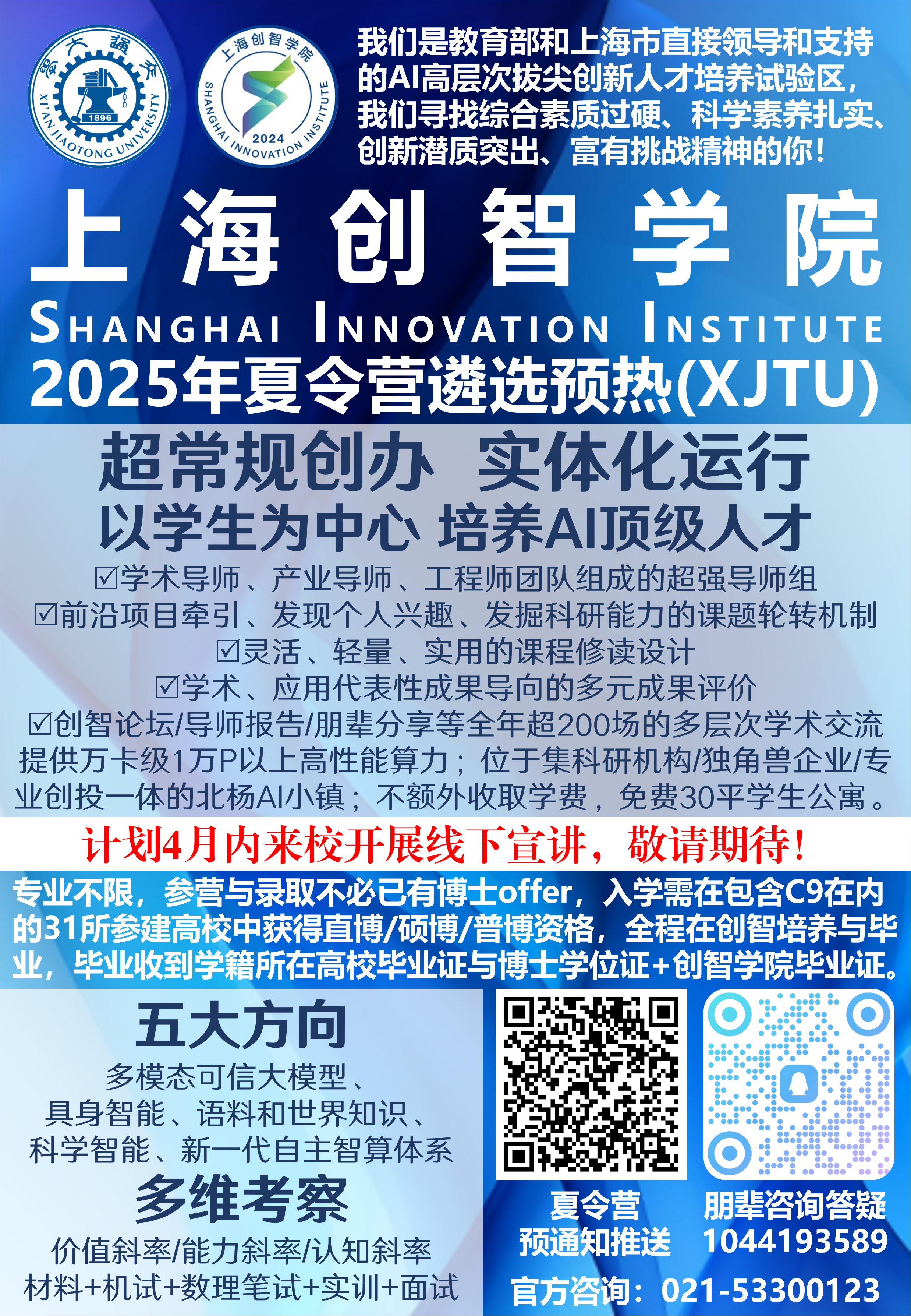
SJTU, come join the fun—welcome everyone to Chuangzhi~



Hello, Teacher Yibu!
What is this for? I haven’t found this in the water source.