This is Jack:

And this is Today:

Jack and Today are dating.

The relationship is fairly okay, and Jack is quite satisfied, but it has been a while, and Jack knows that his current Today is not the right her. Of course, he sometimes has a lot of fun with Today, but many times Jack feels like he is dating an ordinary Wednesday, which is definitely not the kind of Today he intends to date long‑term.
Because he knows this relationship is only temporary, Jack does not invest too much of himself, and instead puts more energy into another person—Tomorrow. Tomorrow is the kind of day he wants to date—fulfilling, passionate, meaningful, and exciting. He knows that sooner or later he will find a “Today” like that, a Today that would only be together when he has found love, his career is soaring, and he lives in his dream city. He can already imagine what she looks like:
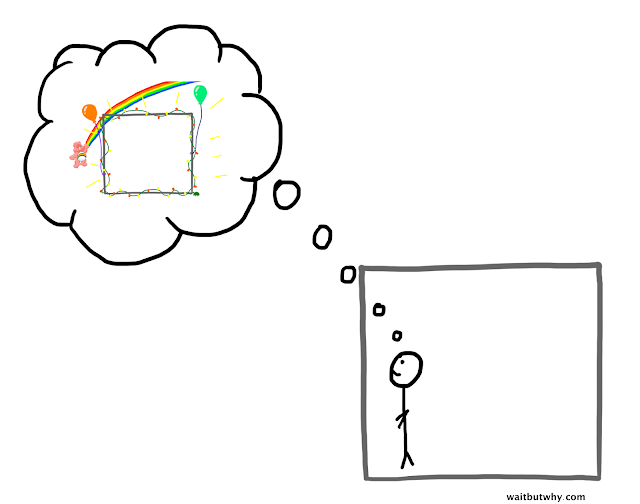
That day will eventually arrive, but at the same time Jack has another plan—he is getting a raise next week, and he intends to break up with his current Today as soon as he gets the raise and start dating a new Today—the post‑raise Today. Of course, she isn’t the kind of Today Jack would marry, but she is far more interesting and exciting than his very ordinary current Today.
The morning after the raise, Jack wakes up feeling especially light‑footed. He is a newcomer with a new Today, and he has already fallen for her:
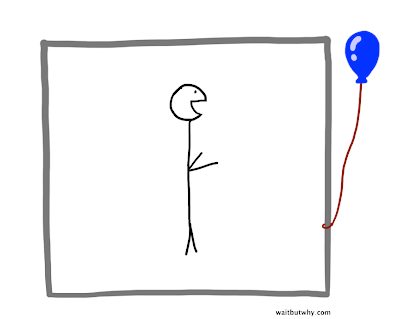
That night he goes to a high‑end restaurant he couldn’t afford the day before, and the next day he buys a new set of golf clubs.
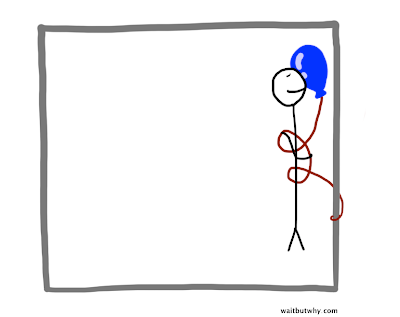
Two weeks later, Jack returns to that upscale restaurant, but it feels a little different. The food is still delicious, but this time it isn’t as thrilling.
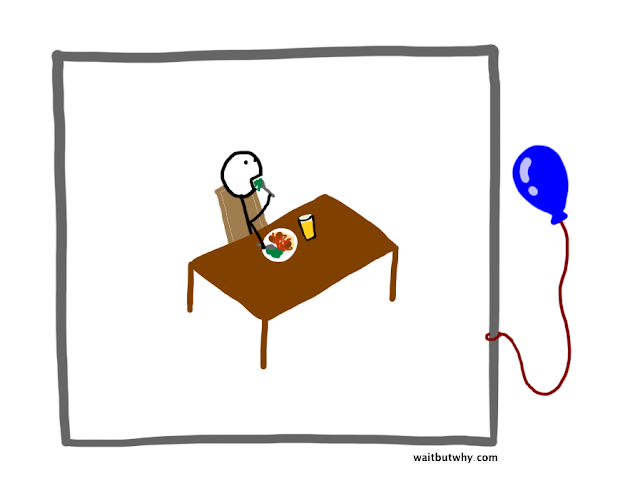
A month later, when he goes out for golf for the fourth time with his new clubs, his mood is completely unaffected by them—it’s just another ordinary golf day.
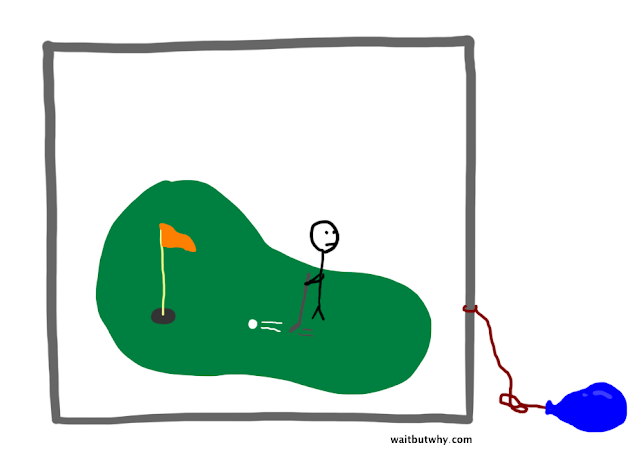
Until one day, the wall looks exactly the same as it did before his raise.

Jack feels confused. He has already left his ex‑Today behind, so why does it feel like he’s dating her again? He thought he had said goodbye to that part of his life.
Although disappointed, Jack just shrugs—this raise is just a small dish, the real future is still ahead, so being unhappy isn’t a big deal.
Years later, Jack reaches an important month. First, after many years of being single, he meets a girl who makes his heart flutter, and they click instantly. She is exactly the person he has been waiting for, and after a few dates she becomes his girlfriend. Almost at the same time, the restaurant‑rating business Jack founded a year earlier is featured in a major newspaper, and the volume of business suddenly spikes. Jack always knew the venture was a good idea, and now it finally has proof. For Jack, everything finally comes together.
His new Today—after his career takes off and he finds a girlfriend—is exactly everything he has dreamed of for the past few years.
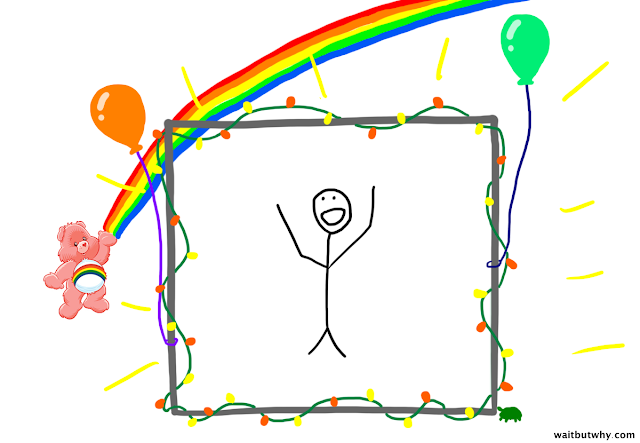
This is the life Jack has always believed he would eventually have—he is that kind of person. His Wednesdays will never be dull again.
But then, things start to change. A few months later, even though his relationship with his girlfriend is progressing smoothly and his career continues to grow, Jack finds that his excitement about Today isn’t what it used to be, making life feel a bit dim. He is busier than ever, almost constantly working. Although he is still satisfied with his new Today, his overall mood is no longer high‑spirited.
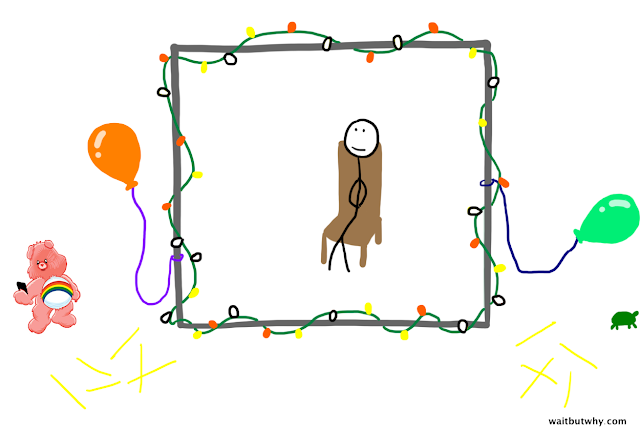
A year later, even though Jack’s life is richer and more meaningful than before, he has fully gotten used to the status quo. He also sees a friend whose career is developing more successfully than his, and wonders what that feels like; another friend seems to have more fun with his girlfriend than Jack does—“Nice,” he thinks.
Until one day, Jack wakes up and finds himself here:

He can hardly believe it. How did she get here?
He considers applying for a restraining order against this ex who won’t leave, but ultimately decides against it—after all, he never intended to marry the Today that comes after his career takes off and he finds a girlfriend. What he truly looks forward to is the Today after he sells his company and marries his girlfriend—that is the Today that can truly make him happy.
Jack’s struggle is not uncommon—most of us experience something similar to some degree. In a brilliant TED talk, Harvard professor Dan Gilbert describes a phenomenon called “impact bias”—our tendency to overestimate how much future events will affect our happiness. Humans can simulate future scenarios in their minds to predict how they will feel, but this mental simulator is not always accurate; it often “makes you believe the differences between outcomes are larger than they actually are.”
Gilbert says: “From field studies to lab experiments, we find that winning or losing an election, gaining or losing a lover, getting or missing a promotion, passing or failing a college exam, and so on, have far less impact on people than they anticipate, both in magnitude and duration.” This even applies to terrible events in our lives. According to Gilbert, “A recent study on how major life traumas affect people shows that if these events happened three months ago, with few exceptions, they have no impact on your happiness.” Jack is clearly a victim of impact bias.
Jack’s dilemma also relates to the “pixel theory,” a concept introduced by Tim Urban in his famous TED talk “Alone in the Apartment Facing the Mirror.”
Jack views his life as a rich picture depicting an epic story, believing that the key to happiness lies in the broad composition of that picture.

But that is a mistake, because Jack does not live in the wide strokes of the picture; he lives in a single pixel of the image—a single Today.

Thus, although from a distance thousands of Jack‑Todays would gradually form a complete picture, every moment of Jack’s actual life is spent in unremarkable Today‑pixels. Jack’s error is ignoring the ordinary Wednesday and focusing entirely on the big picture, when in fact the ordinary Wednesday is the real experience of his life.
He assumes that future Todays will be as vibrant and rich as the grand picture of his life, misunderstanding the ordinary nature of a pixel, regardless of how spectacular a person’s life looks on a macro level. This assumption leads Jack to think his plain Today must be an unsatisfying temporary relationship, whereas in reality it is an inevitable and permanent marriage that he must accept and embrace to be happy.
As for what can make Jack happier in his ordinary Wednesday life, there are many scientifically proven methods, including spending time with people you like, getting good sleep, exercising, doing things you’re good at, and doing good for others.
But perhaps the first thing Jack needs to do is learn gratitude, another scientifically proven path to happiness, and the one he lacks most. Jack spends too much time looking up at the wonderful things that are to come and planning future happiness, without enough time to look down and reflect on how much he once longed for everything he now has.