Original:
https://waitbutwhy.com/2013/09/why-generation-y-yuppies-are-unhappy.html
Hi, meet Lucy.

Lucy belongs to Generation Y, the cohort born in the late‑1970s to the mid‑1990s. She is also part of yuppie culture, which makes up a large proportion of Gen Y.
I have a term for the yuppies within Gen Y—I call them “Gen Y Protagonists & Special Yuppies,” abbreviated GYPSY. A GYPSY is a distinct type of yuppie who sees themselves as the main character in a very special story.
So Lucy is enjoying her GYPSY life and is very satisfied with being Lucy. But there’s one problem:
Lucy is a little unhappy.
To figure out why, we need to define what makes people happy or unhappy. It boils down to a simple formula:

It’s simple—when a person’s life reality is better than they expected, they feel happy; when reality is worse than expected, they feel unhappy.
To give some background, let’s introduce Lucy’s parents:

Lucy’s parents were born in the 1950s—they’re Baby Boomers. They were raised by Lucy’s grandparents, who belong to the G.I. Generation, the “Greatest Generation,” who grew up during the Great Depression and served in World War II—definitely not GYPSY.

Grandparents who lived through the Depression were obsessed with economic security and taught Lucy’s parents to build practical, stable careers. They wanted their children’s careers to be better than their own, so Lucy’s parents were taught to imagine a prosperous and stable career outlook for themselves. Something like this:

They were told that nothing could stop them from achieving that lush, green‑lawn‑like career, but it would take many years of hard work to get there.

After shedding the unbearable hippie phase, Lucy’s parents began their careers. With the 1970s, 80s, and 90s came an unprecedented period of economic prosperity. Lucy’s parents did better than they expected. This left them feeling satisfied and optimistic.

Because their lives were smoother and more positive than their parents’, Lucy’s parents raised her with optimism and a sense of limitless possibility. And they weren’t alone. Baby Boomers across the country—and the world—told their Gen Y kids they could become anyone they wanted to be, embedding a special protagonist identity deep in their psyche.
This gave GYPSYs hope for their careers, to the point that the safe, prosperous green lawn their parents pursued no longer satisfied them. In a GYPSY’s mind, the lawn must have flowers.

This leads to the first fact about GYPSY:
GYPSY Ambitious

GYPSYs need far more than a prosperous, safe green lawn from their careers. In fact, an ordinary green lawn isn’t unique or special enough for a GYPSY. Baby Boomers wanted the American Dream; GYPSYs want to fulfill their own personal dreams.
Karl Newport points out that the phrase “follow your passion” only became popular in the past 20 years, according to Google’s Ngram viewer (which shows how often a phrase appears in printed English over time). The same Ngram shows that “a secure career” has fallen out of favor, while “a fulfilling career” has become increasingly popular.
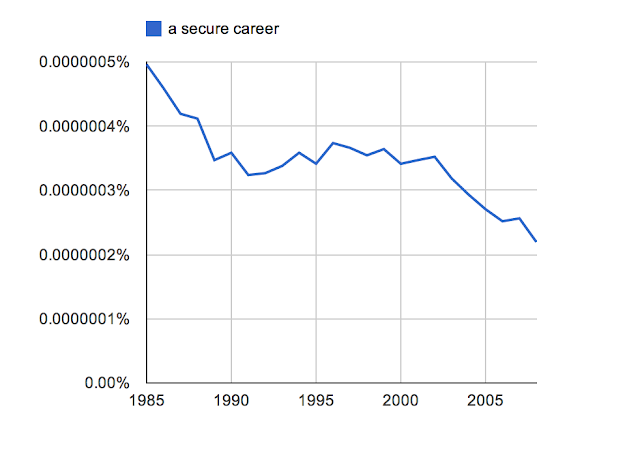
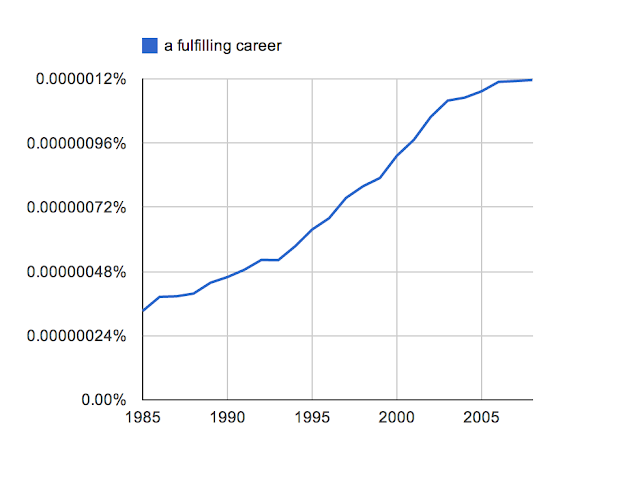
It should be clear that GYPSYs, like their parents, also crave economic prosperity—they just also want a career that provides a level of fulfillment their parents never considered.
But something else is happening. While Gen Y’s overall career goals have become more concrete and ambitious, Lucy received another message throughout her childhood:
You’re Special

Now might be a good time to introduce the second fact about GYPSY:
GYPSY Is Delusional
“Of course,” Lucy was taught, “everyone will pursue a fulfilling career, but I’m exceptionally outstanding, so my career and life path will stand out from the crowd.” So, on top of an entire generation chasing a flourishing career lawn, each individual GYPSY believes he or she is destined for something better—
on a blooming lawn stands a shining unicorn.

Why is this delusional? Because all GYPSYs think this, which contradicts the definition of “special”:
spe‑cial | ‘speSHel |
adjective
better, greater, or otherwise different from what is usual.
According to that definition, most people are not special—otherwise the word “special” would be meaningless.
Even now, GYPSYs reading this article are thinking, “Makes sense… but I’m one of the few special people,” and that’s the problem.
When GYPSYs enter the job market, a second delusion appears. Lucy’s parents expected that years of hard work would eventually yield an outstanding career, but Lucy assumes that, as someone so extraordinary, an outstanding career is a given—just a matter of time and choosing the right direction. Her pre‑employment expectations looked something like this:
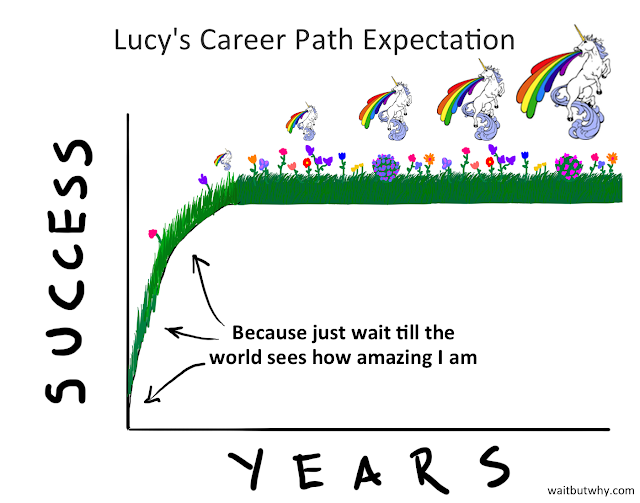
Unfortunately, the real world isn’t that easy, and a career is actually very hard. A great career requires years of sweat, tears, and effort to build—even those without flowers or unicorns. Even the most successful people rarely do anything truly great in their early twenties or early thirties.
But GYPSYs are not willing to accept that easily.
New Hampshire University professor and GYPSY expert Paul Harvey studied this phenomenon, finding that Gen Y exhibits “unrealistic expectations and a strong resistance to negative feedback” as well as “inflated self‑concepts.” He says, “For people with a strong sense of superiority, unmet expectations are a huge source of frustration. They often feel entitled to respect and rewards that don’t match their actual ability and effort, so they may not receive the respect and rewards they expect.”
For employers hiring Gen Y members, Harvey suggests asking in interviews: “Do you feel you’re better than your peers/classmates/etc.? If so, why?” He adds, “If a candidate answers ‘yes’ but gives a vague reason, a superiority issue may be present. This is because the perception of superiority usually rests on an unfounded pride and sense of entitlement. They were indoctrinated from a young age—perhaps through over‑inflated self‑esteem activities—to think they’re special, yet often lack any real basis to support that belief.”
And reality dares to treat “merit” as a factor. A few years later, Lucy found herself in this situation:
merit [ˈmerɪt] n. value; advantage; achievement; virtue
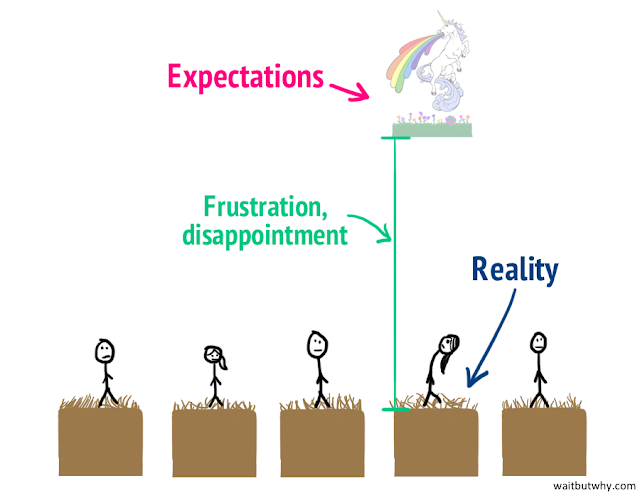
Lucy’s extreme ambition, combined with the arrogance born of a delusional sense of self‑worth, gave her huge expectations for her early post‑college career. Her reality fell short of those expectations, resulting in a negative “reality – expectation” happiness score.
And it got worse. In addition, GYPSYs face an extra problem that applies to the whole generation:
GYPSY Is Mocked
Sure, some of their parents’ high‑school or college classmates ended up more successful than they did. While they might occasionally hear rumors, overall they don’t know much about other people’s careers.
However, Lucy is constantly mocked by a modern phenomenon: Facebook image‑crafting. (What’s the domestic version called?)
Social media creates a world for Lucy where:
A) Other people’s activities are highly visible;
B) Most people present an exaggerated version of their lives;
C) Those who frequently talk about their careers (or love lives) are usually the ones whose careers (or love lives) are progressing best, while those who are struggling tend not to broadcast their situation.
This leads Lucy to mistakenly believe everyone is doing great, which only adds to her pain:
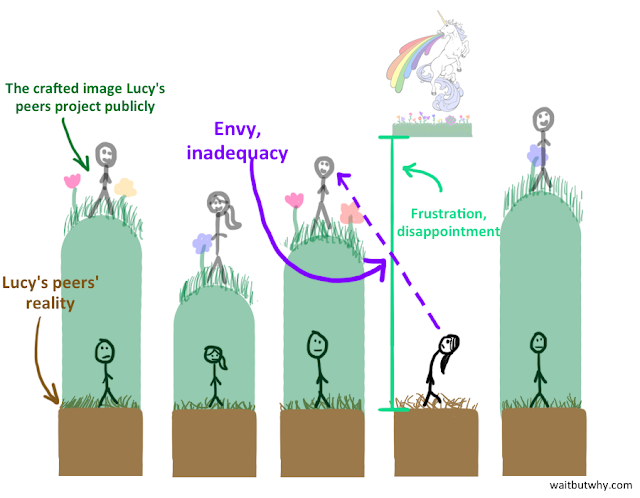
That’s why Lucy is unhappy, or at least feels a bit depressed and inadequate. In fact, her career may have gotten off to a good start, but for her it feels deeply disappointing.
Here are my suggestions for Lucy:
1) Stay ambitious. The world today is full of opportunities; as long as you’re ambitious enough, you can find a flourishing, satisfying success. The exact direction may not be clear yet, but it will resolve itself—just be brave enough to dive into a field.
2) Stop thinking you’re special. The fact is, right now you’re not special. You’re a completely inexperienced young person with little to offer. You can become special through long‑term hard work.
3) Ignore others. Others’ greener grass isn’t a new concept, but in today’s image‑crafting world, others’ grass looks like a glorious plain. The truth is, other people are just as hesitant, self‑doubting, and frustrated as you are; as long as you focus on your own stuff, there’s never a reason to envy anyone.